Friday, December 14, 2012

Hawaii Disaster Warning, Update

Alert period: December 15 - 22, 2012

To Recap:

Changes in observed Hawaiian social mood has generated a signal indicating an event that should be perceived as crisis, disaster, or upheaval by the people of Hawaii is likley to occur within the alert period.

Such events are often related to violence, unrest, or natural disasters.  The local factor related to protests and mass violence is slightly elevated, but not extreme.

The charts below show the "temperature" or intensities of each of several risk factors of U.S. social mood which are also proportionate globally.  If the Hawaii event is related to mass violence, the event or precipitating event would most likely occur  by December 15.


Should a natural disaster be the primary source of the indicated crisis, the most likely type would be a tsunami or volcanic eruption.

Below is the current U.S. damage risk "thermometer" which gives a potential casualty level per type of damage that the social mood would support occuring within the U.S.*
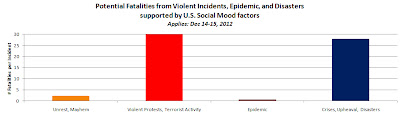


*An event of equivalent impact without fatalities is also possible (e.g. economic loss).

For more information on the MoodCompass Project, see http://moodcompass.com

- - - - - - - - - -
Update: January 3, 2013:
The "Hawaii Disaster" during this period was apparently the death of well-respected, long time senator Daniel Inoyue.  Besides the emotional impact, according to the Hawaii budget head, economically, his death will result in an "economic cliff" for Hawaii, bigger than the federal fiscal cliff.
 

Wednesday, December 12, 2012

Update, Dec. '12 Hawaii Crisis Alert

A confirmation signal was generated by social mood changes in Hawaii that a disaster-type event or series of events is likely in the near future.  The subjective impact to Hawaiians of this event should be greater than the Aurora, CO theater shooting or the Libya ambassador killing was experienced by most Americans.  The event(s) may be described as crisis, disaster, or upheaval.

It should be noted that there is no U.S.-wide signal reflecting a disaster, crisis or upheaval.  Therefore, unless a U.S. signal is generated in the next few days, it is expected to be perceived by Hawaiians as a much more impactful event than is perceived by the average American.

The charts below show the "temperature" or intensity of the risk factors for Hawaii and for the United States as a whole.


 For more information on the MoodCompass Project see: http://moodcompass.com.

Tuesday, December 11, 2012

Crisis Warning, Hawaii Dec. 2012

We are currently monitoring a disaster-type signal generated by changes in the social mood in Hawaii and are waiting for a secondary confirmation signal.  This would indicate a near future event or series of events that would be perceived by the people in Hawaii as a disaster, crisis, or  upheaval.  We will keep you posted, and will update with further details as we get them.

Wednesday, October 10, 2012

Violent-upheaval possible thru Oct. 22


Changes in social mood generated a new signal, creating the following alert:
 
 
There is a high risk for event(s) perceived as crisis, upheaval, or disaster especially between October 12-19. Casualty estimates are between 6 and 60*. 
 
There is an elevated risk for event(s) perceived as violent protests or terrorist activity especially between October 15-22.  A small number of casualties are possible*.
 
Because these signals overlap, they may be part of a single event or set of events, such as a violent-upheaval.
 
Significant natural events may occur during this period. If so, the types most associated with the current pattern are tornadoes (cyclones) and earthquakes.
 
*Estimated casualties are provided to give a sense of scale of expected impact to U.S. society. If the event(s) occur outside of the United States, loss of life and/or property could be substantially greater. An event of equivalent impact without fatalities is also possible (e.g. market failure).

For more information on The MoodCompass Project see moodcompass.com.

- - - - - - -
Update
10/17/12: Man held in NYC plot to blow up Federal Reserve
                Denver bar set on fire with five murder victims inside
10/18/12: Clashes erupt at Greek anti-austerity protests
                  Tornadoes leave thousands without power
                  Google filing error shocks investors
10/21/12:  Gunman shoots 7 at Wisconsin spa

Saturday, October 6, 2012

Unrests, protests, but no disasters

Social Mood patterns indicate a drop in factors related to disaster, crisis and upheaval. Indicators of unrest and violent protests are still elevated.  So, globally, there may be some instances of unrest or protests through October 11, 2012.  However, widespread unrest or violence is unlikely.  Also, the likelihood of any major disaster is low. Enjoy the moment!
 
For more information see moodcompass.com.


Friday, September 14, 2012

Angry, Explosive, Destructive Sept. 14-18, 2012

The social mood is flashing red as we go into this weekend.  In fact, there has been no time this year that such a potentially dangerous collective mood has registered. There are symptomatic events in the news such as the Chicago teacher's strike and the Arab world up in arms, attacking U.S. embassies. You may even have noticed yourself or the people around you feeling extra edgy, argumentative, even explosive.  This mood pattern continues through next Tuesday, so do your best to keep a cool head and prevent any permanent damage to otherwise good relationships.

For further details on the social mood "temperature," and the latest alerts see moodcompass.com.

Friday, September 7, 2012

Violence / Disaster Alert Sept. 11-22, 2012


In both the months of July and August, there was an increase in the level of violence in the category of mass shootings. In July, 12 people were killed and 59 wounded in the theatre shooting in Aurora, CO.  In August, 7 were killed in a shooting at a Sikh temple in Wisconsin.  Several other shootings occured by disgruntled employees, people mad about eviction notices, and a student upset about being bullied.  Increases in these types of events can be predicted.
 
Our Societal Risk Thermometer, which uses changes in social mood to detect the liklihood of such events 1-2 weeks in advance of their occurance, is showing a possible double whammy just ahead.  It is showing a concurrent warning of a mass violent event and a disaster or upheaval type of event.  The warnings for the individual signals are given on our website moodcompass.com.  While these could be two different events or series of event types, with both signals peaking nearly at the same time, does that signal some larger scale event, a violent disaster of some type?  Is the scale of loss of such an event the sum of the two signals (greater than 14 people) or the product (greater than 33 people)?  With limited experience dealing with concurrent signals, we are uncertain how this affects the expected manifestation.
 
Also, as mentioned on our website, estimated casualties are based on the expected impact to U.S. society, and provided to give a sense of scale.  If the event(s) occur outside of the United States, losses of life and/or property could be substantially greater. 
 
Stay alert and keep a cool head, especially over the next two weeks. 
 
- - - - - - - - - - - - - - - -
            9/18: More than 13 people killed in Afghanistan Suicide Attack over film           
 
For the record, this is what was published on moodcompass.com as of Sept. 9:

There is a high risk for violent outbursts, violent protests, and/or terrorist activities on the scale of 3-5* casualties, especially between September 11-18.


There is a high risk for event(s) perceived as a disaster or upheaval with casualties greater than 11*, especially between September 14-22.


Note: The period in which both risks overlap is September 14-18. The effect that concurrent high risks have on likely casualties has not yet been determined.


*Estimated casualties are provided to give a sense of scale of expected impact to U.S. society. Also, if the event(s) occur outside of the United States, loss of life and/or property could be substantially greater.