Showing posts with label socionomic. Show all posts

Sunday, November 19, 2017

Buildup to a Crisis

A crisis appears to be just over the horizon.  It looks to involve the United States.  It could be quite serious and involve mass casualties, or it may be a market disruption with injuries of an economic nature.  I’m finding this one difficult to pin down much beyond "there's a thing here."   It may be that there is no single crisis, but that this marks the beginning of a series of crises.  I will explain the possibilities I am looking at for this initial period through December 3.  Perhaps you can figure it out.   

I track and analyze social mood daily, weekly, and even at longer time frames.  Research spanning two decades shows that internet search trend patterns can give a glimpse into near future categories of news events as well as upcoming market changes.  While the stock market may be overdue for a sharp drop, my primary concern at this moment is a crisis event (whether market related or not) that is likely to occur in the next two weeks.

The method I use begins with converting internet search trends to four primary Mood Qualities, Vulnerable, Expansive, Manic, and Controlled.  The first step in analysis is to look at their changing values relative to each other, and identify any recognizable patterns (see chart below).  This graph of squiggly lines implies that the primary outlook during Thanksgiving week is a combination of a pattern I call “Rose Colored Glasses” and another which points to denial or delusion.  Together these paint a picture of a week where people really would like to tune out negative news, and find a bright side to things if at all possible.  The following week, however, appears to be a crisis point.


Looking at the distribution of social mood geographically can give us more information about the type of crisis to watch for.  Below are global and U.S. MoodMaps for the period of November 19-26.  The WorldMood map shows the U.S. in an aggressive mood, an unstable region around Kazakhstan, and an area marked “destructive” in Northern Chile.  I have no further information about the non-U.S. regions, but they warrant keeping an eye on, as they show an elevated risk as trouble spots. 


A look at the U.S. MoodMap for this same period (below) does not give us any clue about the “aggression” seen on the global map (but hold that thought).  The green area over the East Coast, depicts the kind of mood often described as “the calm before the storm,” or sometimes as “cricket sounds.”  This goes well with the mood pattern from the spaghetti line graph we were looking at earlier, and the idea of trying to look past anything negative or “denial.”


Often the pattern earlier identified as “aggressive” on the world map will coincide with military escalation, or at least with geopolitical bluster.  Yet, without a region showing up as a target of such aggression, it’s of little imminent concern.  Turning the page, so to speak, we will look at the following week’s maps (below).

For November 27 – December 3, the U.S. is shown as destructive and/or disruptive.  The only other region identified as significant is North and South Korea and Japan which are shown as defensive and/or risk averse.  The two weeks' world maps together imply one possible scenario as the United States upping the rhetoric or action in the situation with North Korea during this period.  


Yet again, there is another picture coming from the United States MoodMap.  There is a region showing as “disruptive” centered around New York.  This particular configuration can mean several things.  1) Disruptive activity such as protests or even terrorist activity.  2) Being New York, it can indicate market disruption.  3) A disruptive natural event.  4) Last, but not least, being New York, it could also point to a final Manic market rally.


The only way I can see putting both the global and U.S. maps for this week together would be some type of market disruption that affects the U.S. and East Asia in particular.  However, there can be more than one thing happening here.

In summary, the weekly mood pattern tells us to watch for a crisis event on some level as soon as the weekend following Thanksgiving through Monday December 3.  The maps caution of one possible scenario being the United States escalating the North Korea situation, another possibility being a New York disruptive event such as mass protests, or even terrorist activity.  There could be a disruptive market event, or possibly a severe weather event.  A note of caution to those looking to short the stock market: even IF there is a disruptive market event at some point before December 3, that does not mean there won't be a large rally before or after that.

These maps as well as the mood timeline are not crystal balls, and don't tell us what necessarily will happen.  However, more often than not, they give us a glimpse of a future mood category which in turn allows us to make an educated guess at the type of event(s) which might accompany a given societal "response."

Sunday, June 26, 2016

The Mood Pattern of Terror

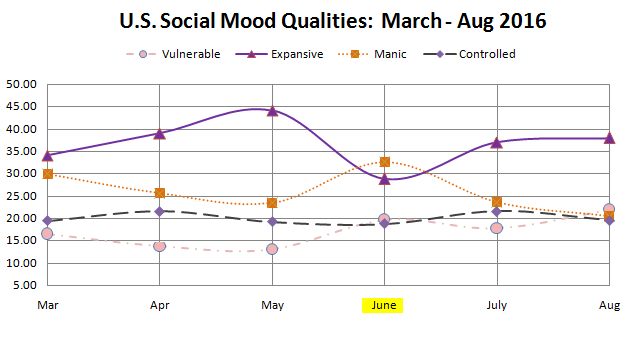
There is an identifiable social mood pattern that is associated with social disruption.  The types of events included in social disruption are protests, strikes, riots, “random” mass violence, and terrorist activity.  An example of this pattern can be seen below in the monthly mood configuration for June.  The basic pattern is high Manic and low Controlled (with mood/effect inverted as it is currently).  When the second highest mood quality is Vulnerable, it ends up being more ideological (e.g. protests and strikes).  When the second highest quality is Expansive, it tends to be more violent.
 
Time scale is important as well.  When this pattern shows up on a daily scale, the events that may arise near that date could be of little significance to the general public and may not even make the news.  On a weekly scale, something in the socially disruptive category is more likely to show up in the news.  On a monthly scale, such as what we have in June, there is almost certainty that a highly significant event or events of this type will be in the news, and will have an emotional impact, at the very least, on the American people (since the measure is U.S. mood).

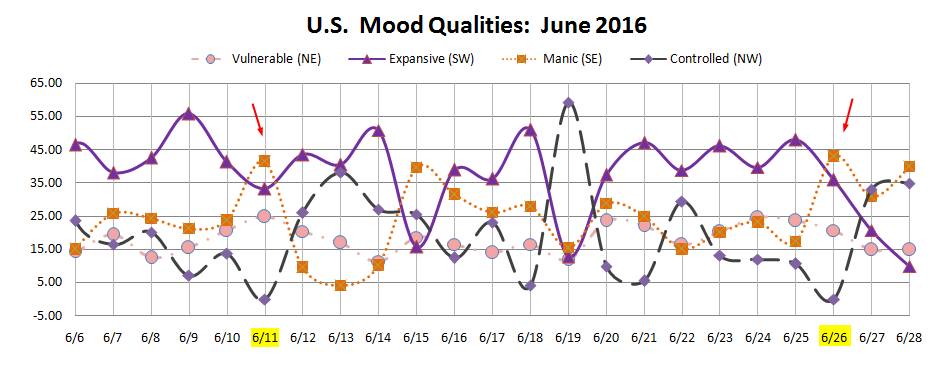
On June 12th, around 2am, the tragic and unfortunate shooting in Orlando occurred.  One can hope that the largest mass shooting in American history would be sufficient to satisfy a monthly scale disruptive mood configuration.  Yet, while not a certainty, there is an indication that something else may be next.  The exact same social mood pattern for the month of June showed up on a daily scale on June 11th, the day before the Orlando shooting.  It shows up again on June 26th (see June daily mood timeline below).  While a daily scale configuration is not usually of newsworthy significance, when it matches the larger pattern, it may be an indication of specifically when it may show up as part of the news cycle.

This is not being shared to create fear or terror.  It is a reminder to use the due diligence that is always important.  That is, staying aware of our environment and looking for unusual activity or behavior in the people around us, and for anything especially out of place.  This is especially true for the next couple of days.

Update: 6/26/16 3pm Pacific Time 
It's not terrorism, but this certainly fulfills the criteria.  Hopefully with no one dying this time: Protesters, white supremacists clash at State Capitol.  Officials: 5 people stabbed, 2 critically injured

Update: 6/28/16
No such luck.  Terrorism strikes again.
Suicide bombs kills 28, wound dozens at Istanbul airport


Sunday, July 26, 2015

U.S. Outlook for August 2015 (video)

Global uncertainty rises and assumptions are challenged, according to the U.S. social mood "weather forecast" for August 2015.  A serious or deadly event on the California coast is also a possibility.
 

Saturday, July 4, 2015

Terrorist Activity Watch: July 7-11, 2015 (video)

A spike in manic mood often accompanies terrorist activity.  U.S. social mood "weather forecast" shows climax disruptive mood event(s) in the week ahead.  This may include a spike in mayhem, protests, and/or terrorist activity in the news.


Update:
The climax event we were watching for was on 7/16, the shooting in Chattanooga, TN in which 5 servicemen died as well as the gunman.  Chattanooga is within the high risk area highlighted by our map, but the event took place a few days outside of our time window.

Friday, June 26, 2015

U.S.: Backlash to Change June 28- July 4, 2015 (video)

Backlash to the many recent changes in U.S. culture should start to be seen in the week ahead. .  U.S. social mood "weather forecast" shows Americans less "nice" and more "rowdy."


Friday, June 19, 2015

U.S. Seeking Shelter June 21-27, 2015 (video)

U.S. social mood "weather forecast" shows Americans feeling nervous about events in the world and within the U.S.  A BIG week for U.S. people.


Update 6/20/15: In the areas forecasted for this week (beginning Sunday) as likely areas of Manic mood or disruptive events, on Saturday evening two gunmen in unrelated incidents shot at a group of people. One was in Michigan, the west boundary of the area we mentioned, and the other was in Pennsylvania, the east boundary of the region highlighted for this week.  While we celebrate that the method we are using is apparently working well, it was disturbing and a bit creepy to get something like this "correct" (even though a few hours outside of our time window).

Saturday, June 13, 2015

New Wave of U.S. Unrest: June 14-20, 2015 (video)


U.S. social mood "weather forecast" shows a new wave of protests and manic mood coming to America in the week ahead.

Update 6/17/15: As noted in the video for increased risk of violence on 16th and 17th, and by location highlighting several East Coast states including S. Carolina , 9 dead in S. Carolina shooting at church Bible study class.

Update: 6/20/15: Yes, there was a new wave of unrest/protests this week. Thousands protest Confederate Flag in South Carolina

Wednesday, June 3, 2015

U.S. Outlook for June 2015 (from Social Mood data)

June is a turning point for the United States internally and internationally.  The chart below is the overall flow of social mood as projected for June 2015. :

(click to enlarge)


Note to our followers: The addition of geographic analysis to our toolkit allows us greater precision than ever before in next-month future forecasting.  Follow along with the news-flo this month and see how well we did translating social mood data into future headlines.

Week 1 (through June 6): Mild and ongoing economic concerns are present, but a major U.S. economic event is unlikely.  Most of the stimulus for economic issues likely come from outside the U.S. (Greece?).

Week 2 (through June 13): There may be residual economic concerns from any events of the first week of June, but they should dissipate during this period. Any stimulus for new economic concerns should primarily come from outside the U.S.  Watch for a significant development in U.S. – China relations near June 11. 

Week 3 (through June 20): There is a moderate risk of civil unrest or disruptive event(s) during this period (see map below).  The region at highest risk is the Eastern States, but there is an elevated risk throughout the country.  Manic mood may also show up financially as rising indicators of inflation.

(click map to enlarge)


Week 4 (through June 27): The outlook of Americans should begin to take a more serious tone this week.  The region North of Texas has the highest projection of this mood factor during this period (see map below, left).  However, this central location may also be indicative of a national shift.  A new wave of economic concerns and domestic issues are starting to take hold in the U.S. There is a moderate risk of civil unrest or disruptive event(s) during this period, possibly expanding or continuing from last week (see map below, right).  The region at highest risk is near Michigan and Ohio, but an elevated risk remains throughout the country.  Manic mood may also show up financially as rising indicators of inflation.
(click maps to enlarge)

Week 5 (through July 4): The outlook of Americans should become much more serious in tone this week, expanding from last week (see map below, left).  The "heartland" of America has the highest projection of this mood factor during this period. Economic concerns and domestic issues are growing and are likely a strong focus of politicians in Washington D.C. and traders on Wall Street as this mood factor is elevated in both D.C. and New York City (see map below, right).  These issues are not necessarily limited to those areas.


(click maps to enlarge)
 

Tuesday, June 2, 2015

U.S. China relations for June 2015 (based on projected Social Mood data)

Continuing our cutting edge work in near-future event forecasting, we present a narrative for the upcoming month's U.S. - China relations. Changing views by the world of the United States and China follow patterns that are projected forward one month.  The data is analyzed and coded into archetypal categories.  This forms the basis for the narrative.  Follow the news flow this month and we'll see how close we got to calling the pattern on this one!

Summary: Near June 11, watch for a significant new development in U.S. - China relations.  The U.S. has the intention of keeping China "in line."  However, China may strategically play this to come out ahead.  Near June 18, China takes a more aggressive stance or tone.
 
(click on maps below to enlarge)


Sunday, August 18, 2013

Collective Mood, Global Events, and the Stock Market

I am starting a new blog just for people interested in social mood's tie-in with world events and the stock market.  That way I can discuss those things with people interested in that, and continue to redevelop this blog with a different focus. 

If you are interested, it is at http://moodcompass-world.blogspot.com

Best regards,

Dr. Cari Bourette
Director,
The MoodCompass Project

Saturday, June 22, 2013

Out with the Old...

Our world is about to change at a pace that has never been seen before in all of human history.  A paradigm shift has begun.  For many it will be painful, for some it will be exhilarating.  The extent of our turmoil may be measured by the persistence with which we cling to the pursuit of how it's always been or to our old ideas of how things should be.  Adaptability and flexibility are key virtues that will get each of us through the days ahead.  Cooperation and community will be hallmarks of success.

The work that MoodCompass has done in tracking disasters has been successful.  We have learned that it can be done, and have demonstrated that there is connection between ourselves and our world.  However, because of where we are at in history, it does not make sense to continue to focus on disasters at this point.  There's a good chance that people will find all the disaster-type events they hear about in the news in the coming years to be overwhelming, or at least something to tune out and turn away from.  We need to find a different focus, and are trying to figure out right now what that might be.

We have discontinued our tracking of social mood's connection with the stock market as well.  The market will be quickly on its way to irrelevancy in the months ahead, as it already is for most people now.

Transformation is magical.  It can be frightening when it happens to us and our world.  Yet, as we let go of what we have clung to, either by choice or by force, we make room for something unexpected and potentially beautiful.  That is our hope for the world, now, and in the years ahead.


Tuesday, June 11, 2013

Weather, Volatility, and Society -- Coincidence?


The National Weather Service on Tuesday is expecting a ramping up of severe weather this week:

"Severe thunderstorms will be possible farther east as the week progresses due to a very unsettled weather pattern."

We have many times presented natural event outlooks based on social mood patterns.  This time we will present the same concept from the other side.  We have seen evidence over and over of a connection between weather, people, and events in general.  Given this weather forecast, watch for an increase in "unsettled" people.  If the pattern plays out as the Weather Service suspects, look for an increase in global stories about protests, riots, violence, market volatility, and natural events such as storms, earthquakes, and fires. 

Are we saying that the weather causes people's moods?  Are we saying people cause the weather?  Are we saying that U.S. weather causes global events?  Not exactly.  We are saying that there is a connection.  They are interdependent.  People and the events in the world are interdependent.  Let's watch this "very unsettled pattern" in our world this week and see how many faces it ends up displaying. 


For more information on the current outlook or the MoodCompass Project, see http://moodcompass.com.
You can also like The MoodCompass Project on undefined.

- - - -
Update 6/13/2013:
Storm was not as bad as feared, so we would expect world news of this energy type to be unsettling, but not as destructive as it could have been. 

Headlines June 13-15, 2013:
Most destructive wildfire in Colorado's history
Dozens hurt in explosion at Louisiana chemical plant
1 dead, others hurt in new explosion in Louisiana
Turkey's protest situation critical
Stocks close out a volatile week
Thousands take to streets of Istanbul
Earthquake hits southern Mexico

Sunday, June 9, 2013

Stopping Disaster

On June 2, we posted a warning of being in the Global Disaster Zone through June 10.  Then an amazing thing happened.  The following day, we moved out of the "zone."  Is that a coincidence?  Did the few hundred people who read the post respond in a way that a global disaster was prevented or delayed?  There's no way to know for sure whether a thing would have happened.  Today, the risk once again nears the critical zone.  Is there a way to stop or delay disaster?  Is it possible to repeat what happened after the June 2 post?

On the right side of the chart below, it can be seen that as of the 1st post, collective mood was just entering the "Global Disaster Zone," and then promptly left it as the blue line moved down the following day.  It began moving up again on Friday, June 7, which also meant an increasing risk of disaster type events.  While not large enough to be considered a disaster, a tragic event occurred, a mass shooting at Santa Monica College in California.  As of today, the disaster zone is getting quite near again.  What will happen this time?


For more information on the current outlook or the MoodCompass Project, see http://moodcompass.com.
You can also like The MoodCompass Project on undefined.

Sunday, June 2, 2013

In the Global Disaster Zone

The last time collective mood was in the Global Disaster Zone, there were the violent storms in the U.S. called Walda followed by the Boston Marathon event, the West Texas fertilizer plant explosion, and then devastating earthquakes in Iran and China.  Before that was a superstorm called Sandy.  What will happen this time?


Collective mood cycles from extreme disconnection from the events happening in the world around us (the news) to a reconciliation where we "wake up" to events that grab our attention or impact us at a deep emotional level.  Like a rubber band being stretched and released, the farther we go during the disconnection phase, the more impactful the reconciliation tends to be.

At the place we are in for about the next ten days, global disasters are more likely than not.  And because the source of this data is U.S. mood, it indicates when events especially impactful to people in the United States should occur.

The themes of events likely to occur at the hands of human beings are organized or directed violence and the experience of victimization or vulnerability.  This could also show up as social instability (e.g. angry protests) or market volatility (violent market moves).  Events likely to occur in Nature should reflect themes of fire and/or flood (e.g. volcanoes, violent storms, and possibly earthquakes).  There is also a background natural theme of epidemic, health, and mortality.

There are more details on the likely disasters in the previous two posts, so let's not belabor that here.  When disasters affect us personally they are tragic, but the point of this is not that we are all doomed.  The point is how amazing it is that our world is connected to us and we are to it.  Disasters are a built in way to get our attention and remind us that we have become disconnected again.  When the rubber band gets pulled to these extremes and released, we all get relatively more connected for a moment.  It would be a really cool thing if there was a time in our not too distant future that we could remind ourselves somehow before the disconnection was so great as to put these things in motion.

For more information on the current outlook or the MoodCompass Project, see http://moodcompass.com.
You can also like The MoodCompass Project on undefined.
- - -
Update:
6/7/13: Santa Monica College Shooting leaves seven dead
 

Thursday, May 30, 2013

Weather, Violence, and Americans

The way we collectively feel (social mood) goes through cycles relative to the news, or the events from "out there" that happen to us.  Sometimes we are really disconnected from the news and the events in it seem really severe compared to our lives and the world we experience.  The cycle then moves toward a place of reconnection where how we feel reflects what is happening in the world around us and the events that occur likewise resonate with how we have been feeling.

We are entering that reconnection phase right now, and for the next week or so, the mood we are in collectively and the events we read about in our world will be in sync.  This is true not just for events about people, but all events.  If we are collectively content, the weather will be generally pleasant, and there won't be a lot of horrible stories of people hurting people in the news.  However, if we are collectively agitated, we will hear of stories of agitated people striking out in random ways and of unstable, agitated weather creating havoc in people's lives.  If we are collectively ready to charge ahead in pursuit of our goals no matter who gets in the way (as the mood is reflecting), we may hear stories of organized violence, terrorist attacks or geopolitical escalation (increased war risk and/or carnage).  The way this primarily shows up in Nature is violent weather, floods, and volcanoes.  With the current pattern, earthquakes and fires would also not be uncommon.

If during these periods, social mood, the stories of people in the news, and the events of Nature are all closely related; and if none of these are the primary cause of the other, but all reflecting one interconnected expression; then by changing one, the others would change.  Even if we can change none of these directly, we can perhaps change ourselves.  For those of us wanting to participate, we can look at how we are pushing to move forward in our own lives.  Being ready to charge ahead is great, there is nothing wrong with a burst of directed action.  However, without understanding, communication or connection of some type with who or what we might be pushing aside or running over, this can become destructive.  The challenge for those who want to try this, is to find this balance in yourself, at least through mid-June.  See if the days you find this balance don't happen to be the days absent of stormy weather and angry or violent news stories.


For more information on the current outlook or the MoodCompass Project, see http://moodcompass.com.
You can also like The MoodCompass Project on undefined.

Tuesday, May 28, 2013

Volatility, Escalation and Volcanoes: Global Mood thru June 10

The social mood through June 10 shows a push for action in a definite direction, for better or for worse.  There is a need for release of the tension that has been building up over the past few weeks.  People have chosen sides and are looking for outlets of expression. It is time to charge ahead!


Incidents of unrest, protests, and workplace violence, as well as other mass violence events should be on the increase during this period.  Risk of terrorist activity is elevated.  Any significant event is more likely to be organized by a group or government than a "lone wolf" individual.  The risk of geopolitical escalation (i.e. war risk), is higher than usual.

World markets may display increased instability and volatility.

Epidemic factors are elevated.  There may be concerns with disease, health, or mortality.  The China bird flu or some other issue may come back into the forefront.

Globally, the likelihood for crises, upheaval, and disasters is elevated; natural disaster risk is on the rise from low levels.

Significant Natural Events:  The types of natural events most associated with the current pattern would reflect the theme of "energy release" and secondarily "liquid."   Events associated with this pattern are volcanoes, floods, violent storms, fires, and earthquakes.


For more information on the current outlook or the MoodCompass Project, see http://moodcompass.com.
You can also like The MoodCompass Project on undefined.
- - - -
Examples of this fiery mood type in the news:
5/31/13: Brawl erupts at Ohio kindergarten
5/31/13: Angeles National Forest Fire grows to 1400 acres
5/31/13: More deadly Oklahoma tornadoes
5/31/13: Four Houston firefighters killed in massive hotel fire

Volatile World Markets:
5/30/13: Rising volatility fuels push to lower risk

New Disease Concerns:
6/1/13: Frozen berry mix sparks hepatitis A outbreak
6/1/13: Why new MERS virus is scary

Sunday, May 19, 2013

Energized and Agitated: Global Mood thru June 2.

The social mood through June 2 shows a transition in progress from manic overconfidence in economic recovery to a period of "bad news."  Yet for now, people are ready for action, and for conquering their world. 

There is also a need for release of the tension that has been building up over the past few weeks.  People have chosen sides and are looking for outlets of expression. Some of  the tension may be released by focusing on events "out there," meaning international in origin or even a natural event.

World markets may begin to show increased instability or volatility at this time.

Globally, the likelihood for crises, upheaval, and disasters is elevated; natural disaster risk is rising from low levels.   

Significant Natural Events:  The types of natural events most associated with the current pattern are earthquakes, volcanoes, violent storms, and fires.


For more information on the current outlook or the MoodCompass Project, see http://moodcompass.com.
You can also like The MoodCompass Project on undefined.

- - -
Update 5/20/13: Two mile wide tornado kills at least 51 near Oklahoma City.

This is what was published on our webpage on 5/19/13 regarding natural events:

Significant Natural Events:  The types of natural events most associated with the current pattern would reflect the theme of Nature vs. Civilization and "energy release", They are likely to "target" populated areas and /or cause disruption to power, communications, transportation, or food supply.  Events associated with this pattern are volcanoes, earthquakes, violent storms, and fires.


Thursday, May 16, 2013

Tragedy, Awe, and Acts of God

The violent storms that have just hit North Texas have left tragedy in their wake; lives have been lost and dreams shattered.  The details are very sad, yet it's possible from a distance to experience a sense of awe and wonder at how the Universe works in the midst of such tragic events.


In the work with the MoodCompass Project we see that on a societal level, that tragic events or disasters may not  be random.  There is a theme or pattern that occurs in social mood that often happens just before a natural disaster such as this.  We call this particular pattern "Nature vs. Civilization."  This is what we said on our webpage on May 14:

"The types of natural events most associated with the current pattern would reflect the theme of Nature vs. Civilization, i.e. they are likely to "target" populated areas and /or cause disruption to power, communications or transportation.  The risk for damage from natural events is low as of May 14, but may suddenly spike higher during this period [May 14-19]."

On the morning of May 15, using only social mood data from Google Hot Trends and top U.S. news stories, our Natural Event indicator spiked to "serious damage possible today in the U.S."  The tornadoes hit that evening.  According to CNN, most of the fatalities occurred when the storm struck a Habitat for Humanity neighborhood.  Most of the 120 homes were destroyed. 

When this type of mood pattern occurs, it often looks like Nature is "aiming" for cities or for necessary aspects of civilization such as transportation, communications or food production.  To see this pattern and then read the quote below from the CNN article may make one pause and wonder about the nature of Nature:

"The National Weather Service warned that a mile-wide tornado reported by spotters had shifted its track and was moving 'right at the city of Cleburne,' a community of about 15,000 people in North Texas."

What would it mean if there was some type of relationship between things we don't normally consider related or connected?  What if on large scales, events that have been considered random have an order, purpose or pattern to them? 

The individual losses are tragic.  Yet, when one steps back and looks at these things from a larger perspective, one can be filled with awe and wonder.  Days before this tragic tornado outbreak occurred that was "aimed" right at the city of Cleburne or right at the heart of a subdivision, the collective mood of U.S. society foretold the possibility of a "Nature vs. Civilization" event.


For more information on the current outlook or the MoodCompass Project, see http://moodcompass.com.
You can also like The MoodCompass Project on undefined.

Tuesday, May 14, 2013

Building Global Tension through May 19


Global mood through May 19 reflects a theme of polarization or "good guys" vs. "bad guys."  While tensions are running high, and ideologies appearing irreconcilable, there may actually be a drop in reports of mass violence incidents.  There may even be a sense of collective euphoria or irrational exuberance as if the troubles of the world may be about to be solved.

Some of this tension should be released in a wave of increased activity and violence after May 19.

Epidemic factors are still somewhat elevated, but less pressing.  There may be continued concerns with disease, health, or mortality.  The China bird flu may continue to be a background issue.


For more information on the current outlook or the MoodCompass Project, see http://moodcompass.com.

You can also like The MoodCompass Project on undefined.

Friday, May 3, 2013

Mass Violence Risk Way Up thru May 13


Social mood shows a global risk of mass violence through May 13.  People are frustrated, angry, and ready to take whatever action they deem necessary.  Protests are on the upswing, and any could easily turn violent with the current mood configuration. 

Collective mood is beginning to transition from the "lone wolf" motif toward more organized violent activities.  This would include government initiated violence.

Epidemic factors are also on the increase.  This is associated with concerns of disease, health, and/or mortality.  This could reflect a separate focus or be a concurrent theme along with expressed violence (e.g. poison, biologicals, etc.)


For more information on the current outlook or the MoodCompass Project, see http://moodcompass.com.

You can also like The MoodCompass Project on undefined.

Update:
5/5/13: Thousands of Islamist Protesters violently demand anti-blasphemy laws
5/12/13: 19 people shot at New Orleans Mother's Day parade