Showing posts with label forecast. Show all posts

Saturday, September 30, 2017

U.S. Terrorist Alert through October 12, 2017

Analysis of internet search trend patterns show a high risk of increased terrorist activity through October 12.  Geographical analysis indicates the highest probability within the U.S. is in the area surrounding Denver, Co.  I hope I have your attention, as an alert such as this is not given lightly.  Let me explain how this is arrived at.

Research spanning two decades shows that daily internet search trends can indicate changes in markets as well as alert to categories of upcoming news events several days before they occur.  Likewise, weekly trends can be used to show changes in markets and categories of news events several weeks before they occur.  Because we are looking at U.S. trends here, it will reflect U.S. and world events which have an emotional impact on people in the United States.

During the time of the source data for this alert, the iPhone 8 and X were announced, Hurricane Irma was completing its run of destruction, and NFL pro football season was beginning.  To convert what we were collectively focusing on at that time into numbers that can be analyzed, we start out with translating the search trends into themes.  For the period in question, this was technology, business, wind, rain, nature, uncertainty, death, men, and sports.  This is then converted into relative intensities of what we call four primary mood qualities: Vulnerable, Expansive, Manic, and Controlled.

The chart below may look like colorful spaghetti, but it gives us a great deal of information on when certain types of events are more likely to occur.  The specific configuration that is showing up for the week ahead (the orange Manic line on top, and the gray Controlled line on the bottom) has occurred only one other time this past year (week ending 5/19).  This pattern indicates societal disruption.  When it shows up on a daily scale, it is usually associated with protests or strikes, but can also be associated with "random violence" and increased terrorist activity.  When it shows up on a weekly scale, it almost always is associated with increased terrorist activity.  The terrorist attack at an Ariana Grande concert in Manchester, England occurred on May 22.  While the timing of market reactions is much more precise, it’s not uncommon for news events to slightly lag behind the mood pattern.


If one looks closely at the above chart, it can be seen that the week of 5/19 and the upcoming week ending 10/6 occur in the area marked “Mood/Effect Inversion.”  The “normal” configuration, the gray Controlled line on top and the orange Manic line on the bottom occurred once this year for the week ending 6/9.  On June 14, a group of Republican lawmakers were attacked by a gunman at a baseball field in Virginia.

Analyzing the geographic distribution of our search trend data, we produced the map below.  The black area marked “destructive” is significant, but it is not clear what this is referring to.  It could be pointing to California, or to something in Mexico or Central America that is serious enough to impact (on an emotional level) people in the United States.  There is nothing to do with this other than wait and see what it might be about.  However, the orange circle very close to the Denver, Colorado area is quite specific.  It’s of the type we are on the lookout for (disruptive) and it’s pointing to a very specific area.  While this does not imply that we are certain that a terrorist attack will occur in the Denver area by October 12, it does mean that during a period where increased terrorist activity is likely, that the highest probability for such an event to occur within the U.S. is near Denver, Colorado.  It’s also important to note that we have not yet completed the map for October 8-15 which could provide us with further insight.

US MoodMap October 1-8, 2017

---
Update Oct. 2, 2017: So far there have been a mass shooting in Las Vegas, terrorist attacks in France and Canada, and violent protests in Catalonia, and the week has just begun.  It's possible that the MoodMap was off and there will be no Denver event.  Perhaps Las Vegas was it.  Let's hope and pray that there is nothing more!

Because this science is in its infancy, we are still learning how to read the MoodMaps.  At times what appears to be multiple events, is actually one event at the center which combines the qualities of all the "pieces."  When the Disruptive component and the Destructive component are taken as one event, it can be seen in the map below that Las Vegas is right in the center.  Surely that event was both destructive and disruptive.


Sunday, June 26, 2016

The Mood Pattern of Terror

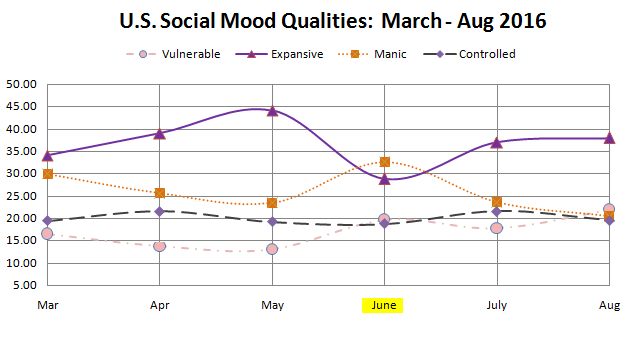
There is an identifiable social mood pattern that is associated with social disruption.  The types of events included in social disruption are protests, strikes, riots, “random” mass violence, and terrorist activity.  An example of this pattern can be seen below in the monthly mood configuration for June.  The basic pattern is high Manic and low Controlled (with mood/effect inverted as it is currently).  When the second highest mood quality is Vulnerable, it ends up being more ideological (e.g. protests and strikes).  When the second highest quality is Expansive, it tends to be more violent.
 
Time scale is important as well.  When this pattern shows up on a daily scale, the events that may arise near that date could be of little significance to the general public and may not even make the news.  On a weekly scale, something in the socially disruptive category is more likely to show up in the news.  On a monthly scale, such as what we have in June, there is almost certainty that a highly significant event or events of this type will be in the news, and will have an emotional impact, at the very least, on the American people (since the measure is U.S. mood).

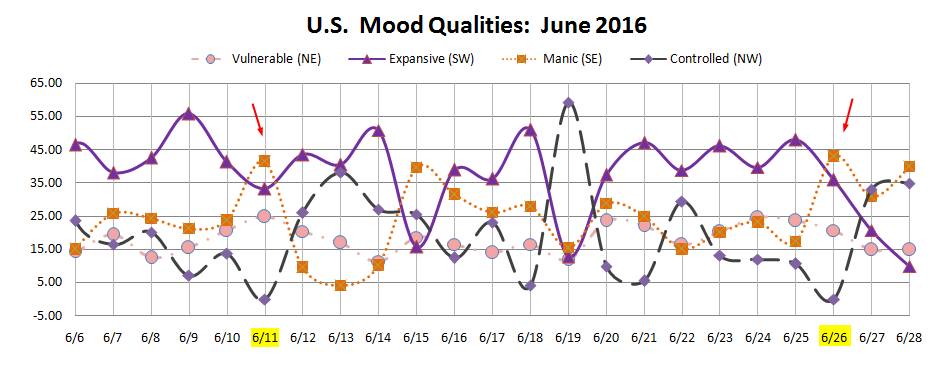
On June 12th, around 2am, the tragic and unfortunate shooting in Orlando occurred.  One can hope that the largest mass shooting in American history would be sufficient to satisfy a monthly scale disruptive mood configuration.  Yet, while not a certainty, there is an indication that something else may be next.  The exact same social mood pattern for the month of June showed up on a daily scale on June 11th, the day before the Orlando shooting.  It shows up again on June 26th (see June daily mood timeline below).  While a daily scale configuration is not usually of newsworthy significance, when it matches the larger pattern, it may be an indication of specifically when it may show up as part of the news cycle.

This is not being shared to create fear or terror.  It is a reminder to use the due diligence that is always important.  That is, staying aware of our environment and looking for unusual activity or behavior in the people around us, and for anything especially out of place.  This is especially true for the next couple of days.

Update: 6/26/16 3pm Pacific Time 
It's not terrorism, but this certainly fulfills the criteria.  Hopefully with no one dying this time: Protesters, white supremacists clash at State Capitol.  Officials: 5 people stabbed, 2 critically injured

Update: 6/28/16
No such luck.  Terrorism strikes again.
Suicide bombs kills 28, wound dozens at Istanbul airport


Saturday, July 4, 2015

Terrorist Activity Watch: July 7-11, 2015 (video)

A spike in manic mood often accompanies terrorist activity.  U.S. social mood "weather forecast" shows climax disruptive mood event(s) in the week ahead.  This may include a spike in mayhem, protests, and/or terrorist activity in the news.


Update:
The climax event we were watching for was on 7/16, the shooting in Chattanooga, TN in which 5 servicemen died as well as the gunman.  Chattanooga is within the high risk area highlighted by our map, but the event took place a few days outside of our time window.

Wednesday, June 3, 2015

U.S. Outlook for June 2015 (from Social Mood data)

June is a turning point for the United States internally and internationally.  The chart below is the overall flow of social mood as projected for June 2015. :

(click to enlarge)


Note to our followers: The addition of geographic analysis to our toolkit allows us greater precision than ever before in next-month future forecasting.  Follow along with the news-flo this month and see how well we did translating social mood data into future headlines.

Week 1 (through June 6): Mild and ongoing economic concerns are present, but a major U.S. economic event is unlikely.  Most of the stimulus for economic issues likely come from outside the U.S. (Greece?).

Week 2 (through June 13): There may be residual economic concerns from any events of the first week of June, but they should dissipate during this period. Any stimulus for new economic concerns should primarily come from outside the U.S.  Watch for a significant development in U.S. – China relations near June 11. 

Week 3 (through June 20): There is a moderate risk of civil unrest or disruptive event(s) during this period (see map below).  The region at highest risk is the Eastern States, but there is an elevated risk throughout the country.  Manic mood may also show up financially as rising indicators of inflation.

(click map to enlarge)


Week 4 (through June 27): The outlook of Americans should begin to take a more serious tone this week.  The region North of Texas has the highest projection of this mood factor during this period (see map below, left).  However, this central location may also be indicative of a national shift.  A new wave of economic concerns and domestic issues are starting to take hold in the U.S. There is a moderate risk of civil unrest or disruptive event(s) during this period, possibly expanding or continuing from last week (see map below, right).  The region at highest risk is near Michigan and Ohio, but an elevated risk remains throughout the country.  Manic mood may also show up financially as rising indicators of inflation.
(click maps to enlarge)

Week 5 (through July 4): The outlook of Americans should become much more serious in tone this week, expanding from last week (see map below, left).  The "heartland" of America has the highest projection of this mood factor during this period. Economic concerns and domestic issues are growing and are likely a strong focus of politicians in Washington D.C. and traders on Wall Street as this mood factor is elevated in both D.C. and New York City (see map below, right).  These issues are not necessarily limited to those areas.


(click maps to enlarge)
 

Tuesday, June 2, 2015

U.S. China relations for June 2015 (based on projected Social Mood data)

Continuing our cutting edge work in near-future event forecasting, we present a narrative for the upcoming month's U.S. - China relations. Changing views by the world of the United States and China follow patterns that are projected forward one month.  The data is analyzed and coded into archetypal categories.  This forms the basis for the narrative.  Follow the news flow this month and we'll see how close we got to calling the pattern on this one!

Summary: Near June 11, watch for a significant new development in U.S. - China relations.  The U.S. has the intention of keeping China "in line."  However, China may strategically play this to come out ahead.  Near June 18, China takes a more aggressive stance or tone.
 
(click on maps below to enlarge)


Thursday, April 23, 2015

Unexpected Explosions of Violence

Violent explosion!  I read those words a few days ago in conjunction with the unexpected eruption of a volcano in Chile.  It made me wonder what was about to happen next.  Unlike many, I do not believe this is an isolated incident, nor is it “random.”  It is part of an overall pattern in play right now (MoodCompass Type: SSE).  This is Nature’s expression of it for the moment.  This same pattern in the human world can look like sudden geopolitical escalation, violent protests, or even terrorist activity.  In the markets it often goes with sudden spikes in the price of oil and gasoline.  There was a violent explosion with an unexpected twist in the news today -- two hostages were inadvertently killed in a drone strike, albeit last January.


Expect the unexpected in world news over the next week or two.  Expect surprising explosive events or violence with an unexpected twist.  Personally, I recommend you do what you can to keep your world calm and centered.  Things will likely get worked out one way or another on the global scene so that “business as usual” may prevail.  There is quite an investment in the status quo, and for now, keeping it in tact is strong motivation for world leaders.  So, whatever volcanoes, skirmishes, or other unexpected explosions appear over the next week or two, do your best to stay cool!

Sunday, August 18, 2013

Collective Mood, Global Events, and the Stock Market

I am starting a new blog just for people interested in social mood's tie-in with world events and the stock market.  That way I can discuss those things with people interested in that, and continue to redevelop this blog with a different focus. 

If you are interested, it is at http://moodcompass-world.blogspot.com

Best regards,

Dr. Cari Bourette
Director,
The MoodCompass Project

Sunday, March 3, 2013

Breaking News: Do We Make Disasters? (video)

Collectively, we may be somehow participating in the making of the disasters that affect the country and world as a whole.  Disaster events of increasing scale are part of a continuous wave that began in June 2012.  As of March 3, 2013, the next U.S. event is on step 2 of a 3 step process.  Can something be done to avoid it?


For more information on the current outlook or the MoodCompass Project, see http://moodcompass.com.
You can also like The MoodCompass Project on .

- - - -
Update 3/5/13:
Next major U.S. event estimated between March 17 and April 9. Still in phase 2 of 3.

Sunday, January 13, 2013

Flu Peaking? Not according to Social Mood

Hope that the flu may be on the decline coincides with a slight decline in the "epidemic" social mood factor that we monitor and is expressed by the CDC in a recent news article.  However, as mentioned in a recent MoodCompass website update, "There may be some hope of an end in site for the flu outbreak in the U.S. but a resurgence in the near future is likely."

Why the pessimism?  At the time they expressed this hope of a peak, the next resurgence was visible in the following week's "epidemic" signal (i.e. Jan. 15 - 24).  Does this come from a crystal ball or specialized tea leaf reading?  Not really.  Signals of next week's destabilizing news events come from *this week's* social mood.  Eight components of social mood on a daily basis are put into equations and out comes any signal spikes relating to events 7 to 14 days ahead.  That may sound strange, and even suggest certain metaphysical assumptions may need revision.  However, it is not any more ethereal than getting next week's weather report today.


For more information on the current outlook or The MoodCompass Project, see http://moodcompass.com.

You can also like The MoodCompass Project on .

- - - - -
 Update:
1/18/2013 CDC: Flu deaths increase sharply

Friday, September 14, 2012

Angry, Explosive, Destructive Sept. 14-18, 2012

The social mood is flashing red as we go into this weekend.  In fact, there has been no time this year that such a potentially dangerous collective mood has registered. There are symptomatic events in the news such as the Chicago teacher's strike and the Arab world up in arms, attacking U.S. embassies. You may even have noticed yourself or the people around you feeling extra edgy, argumentative, even explosive.  This mood pattern continues through next Tuesday, so do your best to keep a cool head and prevent any permanent damage to otherwise good relationships.

For further details on the social mood "temperature," and the latest alerts see moodcompass.com.

Friday, September 7, 2012

Violence / Disaster Alert Sept. 11-22, 2012


In both the months of July and August, there was an increase in the level of violence in the category of mass shootings. In July, 12 people were killed and 59 wounded in the theatre shooting in Aurora, CO.  In August, 7 were killed in a shooting at a Sikh temple in Wisconsin.  Several other shootings occured by disgruntled employees, people mad about eviction notices, and a student upset about being bullied.  Increases in these types of events can be predicted.
 
Our Societal Risk Thermometer, which uses changes in social mood to detect the liklihood of such events 1-2 weeks in advance of their occurance, is showing a possible double whammy just ahead.  It is showing a concurrent warning of a mass violent event and a disaster or upheaval type of event.  The warnings for the individual signals are given on our website moodcompass.com.  While these could be two different events or series of event types, with both signals peaking nearly at the same time, does that signal some larger scale event, a violent disaster of some type?  Is the scale of loss of such an event the sum of the two signals (greater than 14 people) or the product (greater than 33 people)?  With limited experience dealing with concurrent signals, we are uncertain how this affects the expected manifestation.
 
Also, as mentioned on our website, estimated casualties are based on the expected impact to U.S. society, and provided to give a sense of scale.  If the event(s) occur outside of the United States, losses of life and/or property could be substantially greater. 
 
Stay alert and keep a cool head, especially over the next two weeks. 
 
- - - - - - - - - - - - - - - -
            9/18: More than 13 people killed in Afghanistan Suicide Attack over film           
 
For the record, this is what was published on moodcompass.com as of Sept. 9:

There is a high risk for violent outbursts, violent protests, and/or terrorist activities on the scale of 3-5* casualties, especially between September 11-18.


There is a high risk for event(s) perceived as a disaster or upheaval with casualties greater than 11*, especially between September 14-22.


Note: The period in which both risks overlap is September 14-18. The effect that concurrent high risks have on likely casualties has not yet been determined.


*Estimated casualties are provided to give a sense of scale of expected impact to U.S. society. Also, if the event(s) occur outside of the United States, loss of life and/or property could be substantially greater.

Friday, July 6, 2012

Major Event Warning

U.S. Social Mood patterns taken from Google Hot Trends and U.S. News stories indicate a spike in factors related to upheaval and instability. A major event which should have some impact to people in the United States may be imminent.  For the latest information visit http://moodcompass.com.


Update 7/20/12: Manifestation of this signal appears to be a shooting at a showing of a new Batman movie in Aurora, CO.  See link.

Friday, January 22, 2010

China Bubbles, Western Discord, and the Iran Agenda - February 2010 Videocast


Highlights for February: China economic bubble bursts, increased civil unrest, Iranian military escalation, heightened interest in terrorism. A global mood "weather forecast" for February 2010.

Saturday, May 2, 2009

May 2009 – Did Somebody Say “All Clear”?

The Swine Flu may end up not being much more than "the flu," but stay prepared with back up plans for schools, day care, and even groceries "just in case." People can be fickle and hard to predict as to what leads them to decide whether something is worth panicking over or not.

Below is an except from this month's MoodCompass:
- - -

Last month there was an indication of an “unexpected ‘extreme event’ on a global scale.” It was somewhat of a puzzle for us, as the effects on the government appeared to be extreme, yet there was no indication of a stock market crash or heightened geopolitical concerns. If it wasn’t the economy, a war, or a terrorist attack, what could possibly put the U.S. government into such a tizzy? As events unfolded during the month, the swine flu scare was the best fit for this “extreme event.” While we had cited the beginning of the event as likely to be the week of the 13th, the crisis point indicated by our U.S. government chart was April 24-27, exactly where the flu made U.S. (and world) headlines.

As of this writing, there is a downplaying of the seriousness of this flu by the World Health Organization. While its trivialization may or may not end up being a correct assessment, it is important to notice that the alert level is still being maintained at 5. While we are not public health or epidemiology experts in any sense of the word, there are some signals in our social mood and perception charts that encourage continued vigilance for the time being. 1) The global context for the week of May 4 is one of denial of the full extent of a very serious situation. 2) There are indications of a situation that is seen as extremely serious by U.S. society mid to late month with concurrent panic on a global scale. 3) While there may be economic ramifications, the situation does not appear to be primarily economic.

Of course, this is a new month, and there could be completely new problems that fulfill these criteria. The concern is that a brush off of the swine flu and later resurgence of panic regarding its spread or seriousness is much too consistent with the three factors listed above to allow complacency about it just yet. Whether it ends up being “just a flu” in reality or not, panic, and its effect on our daily lives, is all about perception.

- - -
http://anewstory.org/markets/May09_MoodCompass.pdf (current issue viewable by research sponsors only; reprinted with permission of A New Story Foundation)

Tuesday, January 20, 2009

January Addendum - We Have a New President!

Obama is now the 44th president of the U.S. I am very pleased and relieved that it all went so smoothly and beautifully. So, our worries were unfounded! It's interesting that in our work with the MoodCompass we accurately picked up on a large collapse in optimism near the end of the week of the 5th. We also picked up on the change to "panic mode" as Innauguration Day passed. These mood shifts were accompanied by appropriate downturns in the stock market (e.g. today, Innauguration Day, the market was down 5%). As it turns out, the associations with the mood shifts and the upcoming presidential transition were purely circumstantial (thankfully). I will be waiting to see what the forecasted increase in geopolitical interest is all about in the next few days.

The problems that we all have to deal with haven't changed. However, we now have a very gifted leader who will do whatever can and must be done to address the mess that was left for him to clean up. The big question is, will people give whatever is tried a chance to work? Do people, in general, have the patience to wait several years before many of the big problems even begin to get better? I don't envy his position.

Saturday, July 26, 2008

August 2008 – A New Global Reality

August looks extremely interesting. I found it unusually puzzling to put the MoodCompass together for next month. Something big was clearly showing up, but I couldn't figure out exactly what it could be. It must be something outside of the current context, thus the title - A New Global Reality.
Here's this month's MoodCompass excerpt:

This month, something fundamental about our world changes. It may be the way global society conducts business, or perhaps a major revision to the geopolitical situation. Although the extreme scale is clear from the observed and projected social mood cycles, it is difficult to be more specific. While this focal period is only a couple of weeks away, it occurs in a context that is not yet apparent. It takes place in a different reality than the current one; the only one available to interpret the social mood configurations of the coming month.

Near August 8-11 is a global scale “safety seeking” configuration. It resembles the configuration in U.S. social mood at the time of the buyout of the investment bank Bear Sterns in March and the expressed intended bailout of Fannie Mae / Freddie Mac (institutions integral to the U.S. mortgage system) in July. However, what we are concerned with in August is more extreme in scale, and global in scope.

At this same time in U.S. society, we find the “survival focused” configuration. A mini version of this occurred near the end of June. This configuration is marked by a heightened aggressiveness in asserting survival interests or instinctual needs, and a lowered importance or general disregard for the factors necessary to maintain the “economic machine” our society depends on. If prolonged or extreme enough, this configuration can be accompanied by outbursts of civil unrest or disobedience. A public panic crisis event such as we have been urging preparation for would likely occur at or near this type of configuration (see the presentation available at: http://anewstory.org/documents/public_panic_crisis.ppt).

In summary, global society is about to enter a new reality. It should be quite interesting. Grab some popcorn and watch the news. Next month, we should all have a much clearer idea of what this global shakeup was all about.
- - -
http://anewstory.org/markets/August_MoodCompass.pdf
(current issue viewable by subscription only; reprinted with permission of A New Story Foundation)
For the lastest updates on social mood see http://marketmood.net.

Sunday, September 2, 2007

Geopolitical Storms! - U.S. Markets and Mood - September 2007


This is the script for this month's U.S. socioeconomic video forecast:

Greetings, We’ve had fun these past few months making US Markets and Mood forecast videos. This month, however it didn’t seem right to make a funny video. This month, from all appearances, doesn’t look very funny. There is a combination of mood factors for September that deserves something different. So, this month is more of a heart to heart chat. I’ll tell you what it is that we are looking at—you decide for yourself what it means. We’ll start with the lighter side for the month, the stock market and the dollar:

Stock Market: Unlike last month, with the markets ruled by fear and panic at the slightest rumor, most of September should find the markets focused on data and fundamentals. This shift towards rationality should be noticeable by the end of the first week. It is short-lived however, and by the end of the month, expect a full on return to panic.

US Dollar: As for the dollar, look for confusion, as if a shell game was being played. You may pick the first shell, which does look pretty good, that the dollar is going down. You may pick the second shell, which has potential later in the month, which is that the dollar is going up. The third shell may be the best pick, but what is actually under that is a big secret, and we may never get to see what was underneath it. Now, as we continue, I’m going to ask you to piece together a puzzle with me. First let’s look at the mood factors for U.S. Society in general:

U.S. Society: American society is feeling gloomy and a bit haggard after the onslaught of bad economic news last month. One possible response is to go deeper into despair, but that is not what is showing up for this month. The likely way Americans in general will respond to this, is to shift focus to a few designated “bad guys” out in the world. There are many possibilities to choose from—China and Iran are among the recent favorites, but a burst of creativity could even bring in a new villain. This alone, is not a big deal, and nothing new. However, let’s look next at the U.S. government’s mood for this month:

U.S. Government: We all know that both the president and congress have had extremely low approval ratings for some time. Yet, for whatever reason, the indications are that the U.S. Government comes across to the American people in September as both conciliatory and protector, as benevolent and righteous; and if pushed by outside forces, as an Avenger. Another puzzle piece is the energy markets:

Energy Markets: The mood factors for the energy markets indicate extreme volatility and could be full of surprises—the biggest of which should be near the end of the month. There may be times that rationality intervenes and keeps the moves from getting out of hand, but a combination of extreme weather and looming geopolitical tensions may cause panic to win out over reason in the end.

Summary: In summary, the focus seems to shift this month from internal to external factors; and from economic to geopolitical. Whether this means more product recalls with China, more name calling between the U.S. and Iranian presidents, or something more serious we can not know. It seemed to us to be markedly different than what we have been looking at, and it seemed best to frankly share our concerns with you. Take care of you and yours this month. This is Dr. Cari with A New Story—Be well, and be safe.

Saturday, July 28, 2007

Fear Ahead! - U.S. Markets and Mood - August 2007


The mood in general this month is again very gray, almost despondent. What should keep the stock market from completely crashing is the general lack of energy. The biggest danger is the lack of anchor in facts or anything that has to do with "reality." Just like being alone in the deep woods late at night, the slightest creek or crackle can cause incredible panic as the collective imagination runs wild with ferocious beasts, goblins, and monsters. The U.S. government does its best with smooth talking and placating sounds to try to veer away from fears of impending recession. The most likely response from the government to perceived pressure is secrecy, manipulation of social mood, and new constrictive regulations, especially towards the end of the month. From the U.S. perspective, the rest of the world looks pretty sinister, and like a powder keg that could explode into chaos at any moment. The dollar looks unusually strong this month. European currencies and commodities should continue their decline. Crude oil is showing extremely high ambiguity which could manifest as high volatility, but little overall progress in any particular direction.

August 1-10 - ClimaxThe most notable thing early in the month should be highs in overbought markets and lows in the oversold. This is a period of peaks and valleys; markets should be ready to do an about face. Look for "blow-offs" and other tell-tale signs of trend climax.
Week of August 13 - TranquilityThe general mood is indicative of a calming of fears, even relief. The stock market should be making a good attempt at recovery (even if slow). Crude oil should be dropping substantially as the bogeymen that have been propping up the market fail to materialize.

Week of August 20 - EnlightenmentAn epiphany this week should make ambiguities in the markets that have lacked a good sense of direction turn to clarity. It may be another week or two before society in general understands the full implications of this week's events. There is a coming together of mood factors for the U.S. government, the rest of the world, and the factors that influence the price of oil and commodities. However this manifests, it should be interesting.
Week of August 26 - AccelerationThe markets pick up speed (even if down) to end the month off with a loud thud. This may be one of those weeks where the only "market" going up is the U.S. dollar.

Thursday, July 12, 2007

U.S. Markets and Mood - July 2007


July video script:

In July, the economic focus is on practical matters. The mood is somber. There is some concern whether things are going in the “right direction.” The world is watching what looks to them as the demise of the U.S. economy. The response to economic stress is to run from anything suggestive of recession or depression, increasing spending, making deals, and other hypomanic efforts to insure that growth and expansion are still occurring. Another response to difficult news would be an increase in the conciliatory tone of diplomatic effort, and appeasing or comforting those at home.


The U.S. Dollar loses any appearance of strength this month. While the US government turns up efforts at diplomacy and peacemaking. There is a heightened vulnerability towards reacting to domestic stress with external conflict – picking a fight would not be out of the question to distract from problems at home.


Crude Oil: A lessening of bullish factors should lead to a price ceiling. The climb in prices is “empty” – greed chasing its own tail and is difficult to sustain. The bias for the month is for a price decline; however, the market is very sensitive. Any threats or potential threats to supply will send the market climbing.