Showing posts with label terrorism. Show all posts

Sunday, June 26, 2016

The Mood Pattern of Terror

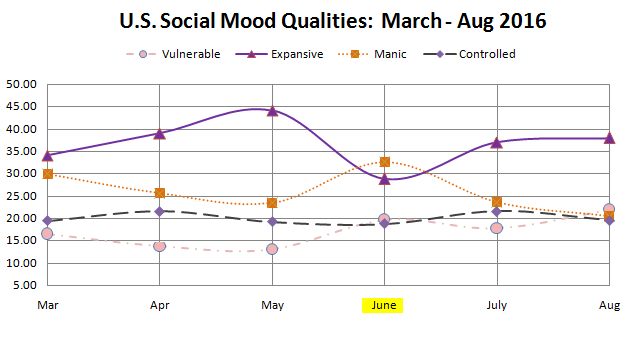
There is an identifiable social mood pattern that is associated with social disruption.  The types of events included in social disruption are protests, strikes, riots, “random” mass violence, and terrorist activity.  An example of this pattern can be seen below in the monthly mood configuration for June.  The basic pattern is high Manic and low Controlled (with mood/effect inverted as it is currently).  When the second highest mood quality is Vulnerable, it ends up being more ideological (e.g. protests and strikes).  When the second highest quality is Expansive, it tends to be more violent.
 
Time scale is important as well.  When this pattern shows up on a daily scale, the events that may arise near that date could be of little significance to the general public and may not even make the news.  On a weekly scale, something in the socially disruptive category is more likely to show up in the news.  On a monthly scale, such as what we have in June, there is almost certainty that a highly significant event or events of this type will be in the news, and will have an emotional impact, at the very least, on the American people (since the measure is U.S. mood).

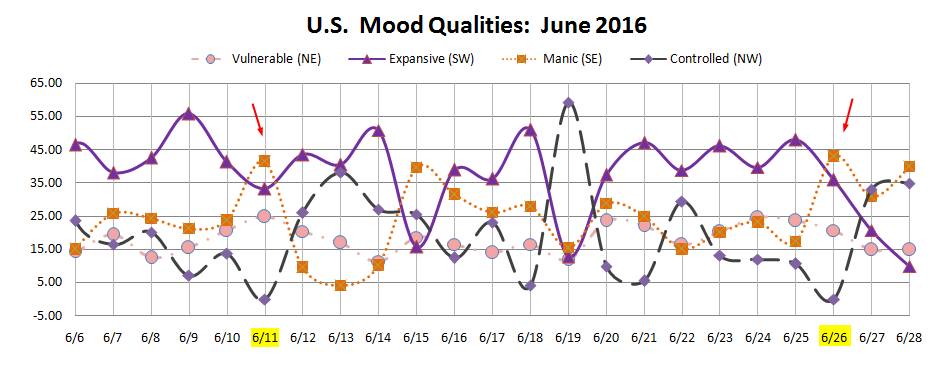
On June 12th, around 2am, the tragic and unfortunate shooting in Orlando occurred.  One can hope that the largest mass shooting in American history would be sufficient to satisfy a monthly scale disruptive mood configuration.  Yet, while not a certainty, there is an indication that something else may be next.  The exact same social mood pattern for the month of June showed up on a daily scale on June 11th, the day before the Orlando shooting.  It shows up again on June 26th (see June daily mood timeline below).  While a daily scale configuration is not usually of newsworthy significance, when it matches the larger pattern, it may be an indication of specifically when it may show up as part of the news cycle.

This is not being shared to create fear or terror.  It is a reminder to use the due diligence that is always important.  That is, staying aware of our environment and looking for unusual activity or behavior in the people around us, and for anything especially out of place.  This is especially true for the next couple of days.

Update: 6/26/16 3pm Pacific Time 
It's not terrorism, but this certainly fulfills the criteria.  Hopefully with no one dying this time: Protesters, white supremacists clash at State Capitol.  Officials: 5 people stabbed, 2 critically injured

Update: 6/28/16
No such luck.  Terrorism strikes again.
Suicide bombs kills 28, wound dozens at Istanbul airport


Saturday, July 4, 2015

Terrorist Activity Watch: July 7-11, 2015 (video)

A spike in manic mood often accompanies terrorist activity.  U.S. social mood "weather forecast" shows climax disruptive mood event(s) in the week ahead.  This may include a spike in mayhem, protests, and/or terrorist activity in the news.


Update:
The climax event we were watching for was on 7/16, the shooting in Chattanooga, TN in which 5 servicemen died as well as the gunman.  Chattanooga is within the high risk area highlighted by our map, but the event took place a few days outside of our time window.

Sunday, June 2, 2013

In the Global Disaster Zone

The last time collective mood was in the Global Disaster Zone, there were the violent storms in the U.S. called Walda followed by the Boston Marathon event, the West Texas fertilizer plant explosion, and then devastating earthquakes in Iran and China.  Before that was a superstorm called Sandy.  What will happen this time?


Collective mood cycles from extreme disconnection from the events happening in the world around us (the news) to a reconciliation where we "wake up" to events that grab our attention or impact us at a deep emotional level.  Like a rubber band being stretched and released, the farther we go during the disconnection phase, the more impactful the reconciliation tends to be.

At the place we are in for about the next ten days, global disasters are more likely than not.  And because the source of this data is U.S. mood, it indicates when events especially impactful to people in the United States should occur.

The themes of events likely to occur at the hands of human beings are organized or directed violence and the experience of victimization or vulnerability.  This could also show up as social instability (e.g. angry protests) or market volatility (violent market moves).  Events likely to occur in Nature should reflect themes of fire and/or flood (e.g. volcanoes, violent storms, and possibly earthquakes).  There is also a background natural theme of epidemic, health, and mortality.

There are more details on the likely disasters in the previous two posts, so let's not belabor that here.  When disasters affect us personally they are tragic, but the point of this is not that we are all doomed.  The point is how amazing it is that our world is connected to us and we are to it.  Disasters are a built in way to get our attention and remind us that we have become disconnected again.  When the rubber band gets pulled to these extremes and released, we all get relatively more connected for a moment.  It would be a really cool thing if there was a time in our not too distant future that we could remind ourselves somehow before the disconnection was so great as to put these things in motion.

For more information on the current outlook or the MoodCompass Project, see http://moodcompass.com.
You can also like The MoodCompass Project on undefined.
- - -
Update:
6/7/13: Santa Monica College Shooting leaves seven dead
 

Friday, September 14, 2012

Angry, Explosive, Destructive Sept. 14-18, 2012

The social mood is flashing red as we go into this weekend.  In fact, there has been no time this year that such a potentially dangerous collective mood has registered. There are symptomatic events in the news such as the Chicago teacher's strike and the Arab world up in arms, attacking U.S. embassies. You may even have noticed yourself or the people around you feeling extra edgy, argumentative, even explosive.  This mood pattern continues through next Tuesday, so do your best to keep a cool head and prevent any permanent damage to otherwise good relationships.

For further details on the social mood "temperature," and the latest alerts see moodcompass.com.

Friday, September 7, 2012

Violence / Disaster Alert Sept. 11-22, 2012


In both the months of July and August, there was an increase in the level of violence in the category of mass shootings. In July, 12 people were killed and 59 wounded in the theatre shooting in Aurora, CO.  In August, 7 were killed in a shooting at a Sikh temple in Wisconsin.  Several other shootings occured by disgruntled employees, people mad about eviction notices, and a student upset about being bullied.  Increases in these types of events can be predicted.
 
Our Societal Risk Thermometer, which uses changes in social mood to detect the liklihood of such events 1-2 weeks in advance of their occurance, is showing a possible double whammy just ahead.  It is showing a concurrent warning of a mass violent event and a disaster or upheaval type of event.  The warnings for the individual signals are given on our website moodcompass.com.  While these could be two different events or series of event types, with both signals peaking nearly at the same time, does that signal some larger scale event, a violent disaster of some type?  Is the scale of loss of such an event the sum of the two signals (greater than 14 people) or the product (greater than 33 people)?  With limited experience dealing with concurrent signals, we are uncertain how this affects the expected manifestation.
 
Also, as mentioned on our website, estimated casualties are based on the expected impact to U.S. society, and provided to give a sense of scale.  If the event(s) occur outside of the United States, losses of life and/or property could be substantially greater. 
 
Stay alert and keep a cool head, especially over the next two weeks. 
 
- - - - - - - - - - - - - - - -
            9/18: More than 13 people killed in Afghanistan Suicide Attack over film           
 
For the record, this is what was published on moodcompass.com as of Sept. 9:

There is a high risk for violent outbursts, violent protests, and/or terrorist activities on the scale of 3-5* casualties, especially between September 11-18.


There is a high risk for event(s) perceived as a disaster or upheaval with casualties greater than 11*, especially between September 14-22.


Note: The period in which both risks overlap is September 14-18. The effect that concurrent high risks have on likely casualties has not yet been determined.


*Estimated casualties are provided to give a sense of scale of expected impact to U.S. society. Also, if the event(s) occur outside of the United States, loss of life and/or property could be substantially greater.

Friday, July 6, 2012

Major Event Warning

U.S. Social Mood patterns taken from Google Hot Trends and U.S. News stories indicate a spike in factors related to upheaval and instability. A major event which should have some impact to people in the United States may be imminent.  For the latest information visit http://moodcompass.com.


Update 7/20/12: Manifestation of this signal appears to be a shooting at a showing of a new Batman movie in Aurora, CO.  See link.

Thursday, December 1, 2011

Persian Gulf Escalation - Dec '11 (video)

Analysis of changes in collective mood and perception indicate a high risk of geopolitical escalation in the Persian Gulf in December 2011.

Monday, October 31, 2011

Teetering on the Edge (Again) - Nov 2011

Highlights:  High risk of U.S. Government budget impasse ∙ Increased risk of terrorist activity ∙ Extreme societal tension and polarization ∙ In Nature: Heavy rain and snow near the holidays.

      November looks like a busy month for world leaders, as they continue to try to manufacture growth where little can be found.  There is a high risk of a U.S. budget impasse that does not get resolved in time.  The U.S. government perception cycles show high activity (battles) through November 17 (the deadline), shifting to dialogue and negotiations through the 22nd.  The timing would suggest an agreement not reached in time, causing increased societal distress and further distrust of the government as the holidays approach.

      There is a heightened global risk for terrorist activity mid-month, along with increased protests, and possible increase in "random acts" of violence.  In the natural world, an increased chance of heavy rain and snow near the holidays should make travel interesting.

Socioeconomic and Geopolitical events:
There are three major periods indicated for November --

November 1 - 8   Into Action.     
November 9 - 17   Turbulence. 
November 18 -30   It's the Economy, Stupid. 
(further details available in the full version of MoodCompass) 

Global natural events:
November   4 - 16  Active, In Motion.  Nature is in the news.  Elevated risk of unusual or increased tectonic activity.

November 16 - 28   Wet, Stormy.  Increased risk of heavy rain and snow.


The above is an excerpt from the November 2011 issue of MoodCompass, a publication of A New Story Foundation. To view the latest projections related to human perception of the natural world, see Earth Cycles.

Saturday, October 15, 2011

A Glitch in the Global Matrix

One can see the European crisis and market turmoil coming to a peak October 3rd and 4th reflected in this excerpt below from the October issue of MoodCompass.  October 4th brought in the period in which the social mood reflected a sense of "new life," as forecasted.  In the short time horizon of market traders and politicians, this was reflected in global stock market rallies, and political negotiations that showed hope of possibly moving past deadlock. 

So what of the current phase entitled "A Glitch?"  The G20 is in negotiations this weekend.  Are they going to break down or be otherwise ineffective as this "chapter" unfolds?  Do global protests begin to appear out of control or become violent in some way?  Something the larger society considers "crazy," "surprising," "contrary," and possibly violent is the likely manifestation of the current configuration.  If possible, staying close to home and staying informed of the latest events may be a prudent course of action.

From the October MoodCompass:
October 1 - 3  An Ending.  Risk aversion is high.  Focus on global economy and stability.  Geopolitical issues.    

October 4 - 12  A New Start.  Global leaders focused on calming things down and restabilizing the global system.  U.S.. government searches for common ground between various groups in dialogue and negotiations. 

October 13 - 18 A Glitch..  Discussions and negotiations may break down.  There's an increased risk of protests, terrorist activity, and "random acts' of violence.

Sunday, October 2, 2011

Strategizing Stability - October 2011

October Highlights: Discussion, dialogue, and negotiations∙ Increased risk of terrorist activity ∙ Grass roots protests and movements on the rise ∙ In Nature: Increased volcano and earthquake risk.

Socioeconomic and Geopolitical events:
There are four major periods indicated for October--


October 1 - 3 An Ending.
October 4 - 12 A New Start.
October 13 - 18 A Glitch.
October 19 - 31 Trigger Point.

(further details are available in the October issue of MoodCompass)

Global natural events:

October 1-11 Hot, Active. High energy in the system may enhance storms and flooding. Increased risk of volcanic activity.

October 12 - 18 Windy, Stormy.

October 19 - 31 Unstable. Increased risk of moderate earthquakes.

 
The above is an excerpt from the October 2011 issue of MoodCompass, a publication of A New Story Foundation. To view the latest projections related to human perception of the natural world, see Earth Cycles.

Sunday, May 22, 2011

The U.S. Strikes Back - June 2011 Alert (video)

Highlights: Collective mood analysis indicates a dramatic change in global context associated with 1) A group or nation crossing a line, end of May. 2) The U.S. striking back in the month of June. Technical presentation illustrates.


Monday, May 9, 2011

Tuesday, May 3, 2011

May 2011 - The Edge of the Cliff

Highlights: New level of global violence/warfare ∙ Increased patriotism/nationalism and willingness to fight for beliefs ∙ U.S. government decreased capacity to make rational choices ∙ Special Alert: Violence and instability in Korea and/or China

The above is an excerpt from the May 2011 issue of MoodCompass, a publication of A New Story Foundation. To view the latest projections related to human perception of the natural world, see Earth Cycles.

Starting this month, MoodCompass is available to the general public. You can view the current issue at http://moodcompass.com/.

Thursday, April 21, 2011

Terrorism, War & Asia - May 2011 Alert (video)

Analysis of collective mood factors indicate acceleration of global violence mid to late May. Most likely scenarios are Korean military escalation or E. Asia terrorist attack. Technical presentation illustrates.

Monday, February 28, 2011

March 2011 - The Bigger They Are...

The wave of unrest and violence which began in North Africa, continues to sweep around the world and arrives in the Americas in the month of March. With tension between parties and ideologies at extremes in the United States, it should not be surprising if it takes an explosion of violence to restore a semblance of sanity, even if only for a brief moment. This could be the beginning of a long and painful decline; QE2 or 3 or 4 not enough to put Humpty together again. The Empire has no clothes.

Human perception of nature in March is “stormy” in North America; a fitting parallel. Asia, becoming increasingly troubled or ill this month in a socioeconomic sense, shows a parallel in a potentially destructive natural event associated with sickness or disease. As the month comes to a close, and the geopolitical picture becomes more ominous, don’t be surprised if a volcano or two joins in the chorus.

March Highlights:
Civil unrest/violence ∙ U.S. instability ∙ Asia environmental crisis ∙ Stock market sell-off ∙ Storms, volcanoes, and earthquakes

The above is an excerpt from the March 2011 issue of MoodCompass, a publication of A New Story Foundation. To view the latest projections related to human perception of the natural world, see Earth Cycles.

Monday, October 18, 2010

High Terror Risk Alert - Oct / Nov 2010: Video

High Terror Risk collective mood configuration appears late October - early November 2010. Technical presentation of mood cycles illustrates.

Sunday, February 28, 2010

Global Violence, Destabilization, and Disasters - March 2010

March is said to come in like a lion, yet along with the nascent Chinese Year, it makes its entrance in 2010 as a tiger-- and a ferocious one at that. The month begins with global tempers high and violence on the rise, as the mood factors indicate a period of global destabilization and violence. It is likely that concerns with civil unrest and even terrorism are at extremes. Worries about geopolitical escalation should be elevated as well.

By the second week of the month, geopolitical escalation could well become a reality. There are indications of concerns during this period with resource availability, and the price of crude oil and other commodities could rise accordingly. Hoarding is a possibility.

As the mid-month point passes, the collective mood indicates a safety-seeking preference; economic losses are likely to accelerate with steep market declines possible. Concurrently, the human perception of the natural world signifies a high risk for event(s) of which losses of life and property are probable.

As the month comes to a close, global leaders are likely to be in panic mode as they attempt to keep up with the extreme pace of unfolding events. The U.S. government also shows indications of being in a crisis mode as it tries to forge a way forward. There should be an attempt to assess losses during this final period and for markets to make their best efforts to stabilize. While valiant attempts may be made throughout the month to catch this tiger by the tail, it’s sure to be a difficult, if not dangerous venture.

- - -
The preceding was an excerpt from the March 2010 issue of MoodCompass. (current issue viewable by research sponsors only; reprinted with permission of A New Story Foundation)

Sunday, January 31, 2010

A New World Dis-Order - February 2010

In February, we begin to see a broad unraveling of the threads that hold the modern global system together. The Chinese economic bubble should finally begin to burst. In the West, social discontent runs high. International tension is extreme this month, and there are sides to be chosen. In the Middle East, look for Iran to go out of its way to display its military might to the rest of the world. The United States may be cornered into making a decision in the direction of aggressive or hostile action, as the rest of the world urges restraint. There is also a heightened interest in terror and terrorism.

To top it off, it may even feel like the natural world is against us, and what we need to maintain our way of life. Unseasonal weather may threaten agricultural outputs, or impede the continuance of business as usual. Tectonic events may encumber additional population centers besides the ones already hit last month in Haiti. It could be a difficult month to be a modern, globalized, civilized human being.

“When the next long term peak in optimism arrives, that will be the time to look for things to really begin to get bad!" (March 2009 MoodCompass, pg. 2). That peak occurred in January. This is evidenced by the ending of the stock market rally that began last March and the beginning of the next long decline—not only in the markets, but in economic, social and geopolitical stability. This is the new world dis-order, and should be for some time to come. If one has focused solely on amassing wealth in terms of dollars and property, one may be disappointed when much of their value is lost. Those who have been investing in relationships-- family and trustworthy friendships-- should find their investments substantially increasing in value over time; precious commodities that cannot be purchased at any price.
- - -
The preceding was an excerpt from the February 2010 issue of MoodCompass. (current issue viewable by research sponsors only; reprinted with permission of A New Story Foundation)